What Moves Your Face and Jaw?
A clear look at expression muscles, chewing muscles, and the jaw’s relationship with the head and neck—and what “muscle tension” can and cannot tell us.
By The re:FLOW team
A clear look at expression muscles, chewing muscles, and the jaw’s relationship with the head and neck—and what “muscle tension” can and cannot tell us.
By The re:FLOW team

Beneath the Surface: Understanding Your Face — Part 3 of 5
Have you ever noticed your teeth pressed together during a busy afternoon, or reached up to rub your jaw at the end of the day? Most of us have one word for moments like these: tension.
It is a useful word for describing how something feels. It says less about what is happening underneath.
Part 1 mapped the tissues beneath your skin, and Part 2 explored the connections that support them. Now we turn to movement: which muscles do what, how the jaw relates to the head and neck, and where anatomy reaches its limits.
Muscles of facial expression begin on the surface of the skull. Their fibers then intertwine with connective tissue and the dermis, the deeper layer of skin. That is why a smile moves skin rather than a joint.
Chewing muscles, also called muscles of mastication, have a different job: they move the lower jaw, or mandible. Learn about the muscles of the head with OpenStax.
The two groups also take direction from different nerves. The facial nerve controls expression. The trigeminal nerve controls the chewing muscles and carries sensation from the skin of the face. See how OpenStax describes these nerves.
So raising an eyebrow and clenching your teeth may both feel like “using your face,” but they involve different muscles and different nerve supplies.
The masseter runs from the arch of your cheekbone to the outer surface of your lower jaw. It raises the jaw to close your teeth, and it is often described as the main chewing muscle.
The temporalis starts on the side of your skull, above and in front of your ear. It narrows into a tendon that passes beneath the cheekbone arch and attaches to the jaw. Its front and middle fibers help close the jaw, while its back fibers draw the jaw backward.
Two deeper muscles, the medial and lateral pterygoids, help with side-to-side and forward jaw movement. Read the StatPearls overview of the chewing muscles.
Neck muscles balance, move, and rotate your head, and that head movement is closely tied to what your jaw is doing.
In a small motion-recording study of 12 healthy young adults, rhythmic jaw movements were paralleled by head movements. A second study of 24 healthy people found that head and jaw movements were coordinated in time during jaw opening and closing. Read the jaw and head-neck movement study and the timing study.
These studies support a working relationship between the regions. They do not show that a tight neck causes jaw discomfort, or the reverse.
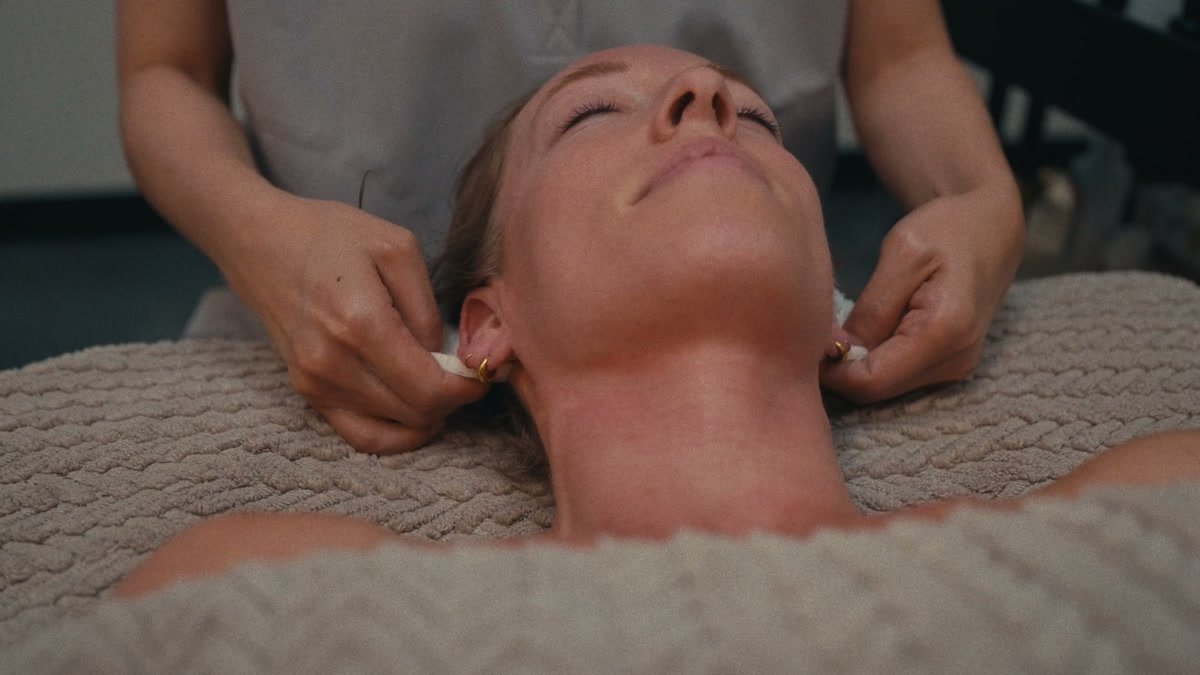
In everyday speech, tension can mean tightness, fatigue, effort, or simply a sense that an area needs attention. Those are real experiences, but they are not measurements of a muscle.
Bruxism offers a helpful comparison. The term describes repetitive jaw-muscle activity such as clenching or grinding the teeth, or bracing the jaw. An international expert group proposed grading how sure anyone can be that it is occurring:
The authors note that this grading still needs further research. Even so, the lesson is useful: noticing something and confirming it are different steps. Read the international consensus on bruxism.
A tight feeling does not identify which structure is responsible. Neither does the shape of a jawline. As we saw in Part 1, facial contours reflect bone, muscle, fat, and skin together, so a wider-looking lower face does not establish that someone clenches or has a large masseter.
Jaw discomfort is similarly complicated. The National Institute of Dental and Craniofacial Research explains that the exact cause of temporomandibular disorders, a group of conditions affecting the jaw joint and chewing muscles, is unclear in most cases. No widely accepted standard test exists, and symptoms can overlap with those of other conditions. Read the NIDCR guide.
If you have jaw pain, stiffness, or a jaw that locks or will not open fully, a dentist or doctor is the right person to assess it.
The takeaway: “tension” describes what you notice, not a diagnosis. Your description is valuable because it tells us where to begin the conversation.
Before your visit, share where you notice tightness, when it tends to appear, and what feels comfortable. At , facial therapy includes attention to the neck, head, and surrounding soft tissues.
How a session feels matters. Still, feeling more relaxed afterward does not show that a particular muscle has changed, and anatomy alone does not establish that hands-on care corrects posture or reshapes the jaw.
Next in the series: Part 4 explores facial fat and tissue fluid, and why a fuller-looking face has more than one possible explanation.
Journal
Not sure which session is right for you? Reach out before booking — every body is different, and we're here to guide you.