Facial Fullness: Fat, Fluid, or Something Else?
Facial fat and tissue fluid are different things. Learn how each works, how lymph moves, and why a fuller-looking face has more than one possible explanation.
By The re:FLOW team5 min read

Beneath the Surface: Understanding Your Face — Part 4 of 5
It is a familiar moment: you glance in the mirror and your face seems a little fuller than usual. It is tempting to reach for a quick explanation: “That must be fat,” or “My lymph must be blocked.”
A mirror cannot settle either one. Fat and tissue fluid are different things, and fullness can have other explanations too.
In Part 3, we looked at how your face moves. Here, we look at two things that are often confused when we talk about facial volume.
Facial fat is organized into compartments
Beneath the skin, the face has fat arranged in compartments rather than one continuous cushion. Dissection research on 30 cadaver half-faces described separate subcutaneous compartments, including areas of the forehead, cheek, around the eyes, and the jowl. Read the fat compartment study.
A later dissection study described deeper compartments in the inner cheek as well, which is why “cheek fat” is not a single thing. Read the deep cheek fat study.
Compartments may also differ with age. A small CT study of 12 cadaver heads, comparing people aged 54 to 75 with people aged 75 to 104, found differences in compartment position and volume. Because it compared groups, it cannot show how any one person’s face changed or explain what you see today. Read the CT study.
Tissue fluid is something else
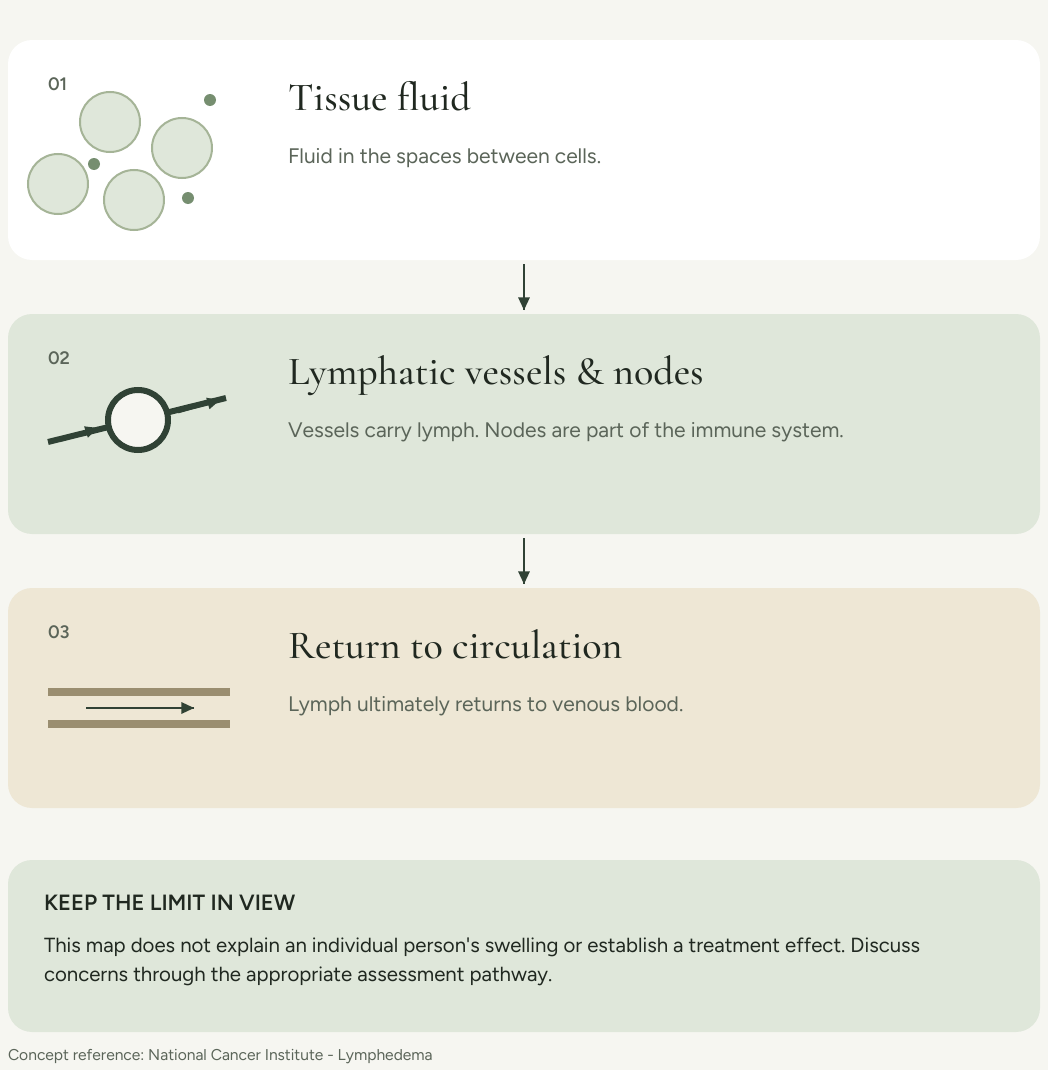
Fat is a tissue made up largely of fat-storing cells. Tissue fluid, or interstitial fluid, is the watery fluid in the spaces between cells throughout the body.
It forms when pressure pushes fluid out of tiny blood vessels. A healthy body is constantly producing and clearing it. Textbooks often describe much of this fluid returning directly to the blood vessels. More recent physiology research has refined that picture, finding that in most tissues slight outward filtration continues and lymphatic vessels play a central part in clearing the fluid. Read the review of fluid exchange and the review of interstitial fluid and lymph.
How the lymphatic system handles fluid
Once tissue fluid enters a lymphatic vessel, it is called lymph.
- Entry: the smallest lymphatic vessels are built from overlapping cells that open to let fluid in when pressure around them rises.
- Movement: the heart does not pump lymph. Body movement, skeletal-muscle contraction, and breathing help move it, and one-way valves keep it heading in one direction.
- Nodes: lymph passes through lymph nodes, which are part of the immune system.
- Return: lymph ultimately rejoins the blood through large veins near the base of the neck.
Explore the lymphatic system with OpenStax.
In the head and neck specifically, cadaver studies have traced lymphatic vessels starting in the dermis, with collecting vessels sparser in the face than in the scalp and side of the neck. Those studies map anatomy; they do not assess how well an individual’s lymphatic system is working. Read the study of vessel structure and the study of drainage patterns.
Why fullness is not automatically fat or blocked lymph
Looking at a fuller face cannot tell us which tissue is involved. As Part 1 and Part 3 explored, bone structure, muscle, fat, and skin all contribute to contour.
Swelling, meanwhile, has many possible causes. MedlinePlus lists allergic reactions, sinusitis, a tooth abscess, salivary gland disorders, certain medicines, injury, and surgery, among others. Blocked lymph is only one specific idea, and it is not something a mirror, a photograph, or a therapist’s glance can establish.
Please seek care rather than booking a facial session if swelling needs medical attention. According to MedlinePlus:
- Get emergency treatment for swelling with breathing problems, or swelling caused by a burn.
- Contact a healthcare provider right away for sudden, painful, or severe swelling.
- Contact a provider for swelling that lasts or worsens, or comes with fever, tenderness, or redness.
Read the MedlinePlus guide to facial swelling.
What the evidence can and cannot say about hands-on care
Much of the formal research on manual lymphatic drainage concerns people with diagnosed lymphedema. A Cochrane review of six small trials in breast cancer–related lymphedema found the technique was well tolerated and might add some benefit to compression bandaging for arm swelling, while calling for confirmation. Those findings do not tell us what it does for everyday facial fullness. Read the Cochrane review.
Nothing here shows that hands-on care dissolves fat, repositions fat compartments, or permanently removes fullness.
What this means for your facial care
The takeaway: describe what you notice rather than naming a cause. “My face feels fuller this week” is more useful than “I have blocked lymph.”
Tell the studio when you first noticed the change, whether it comes and goes, and about any recent procedures or health concerns. At , facial therapy includes attention to the neck, head, and surrounding soft tissues, with your comfort in mind and realistic expectations from the start.
Next in the series: Part 5 turns to skin physiology, including why hydrated skin and swelling in deeper tissues are not the same thing.