What Keeps Your Skin Hydrated and Resilient?
A clear guide to the epidermis, skin barrier, hydration, collagen, and elastin—why hydrated skin is not the same as swelling—and a recap of the five-part series.
By The re:FLOW team5 min read

Beneath the Surface: Understanding Your Face — Part 5 of 5
Has your skin ever felt tight and dry after cleansing, even on a day your face looked a little full? Those two observations can seem contradictory. They make more sense once you know they can involve different tissues.
In Part 4, we looked at fat and fluid beneath the skin. In this final part, we come to the surface itself, then bring the whole series together.
The epidermis and the skin barrier
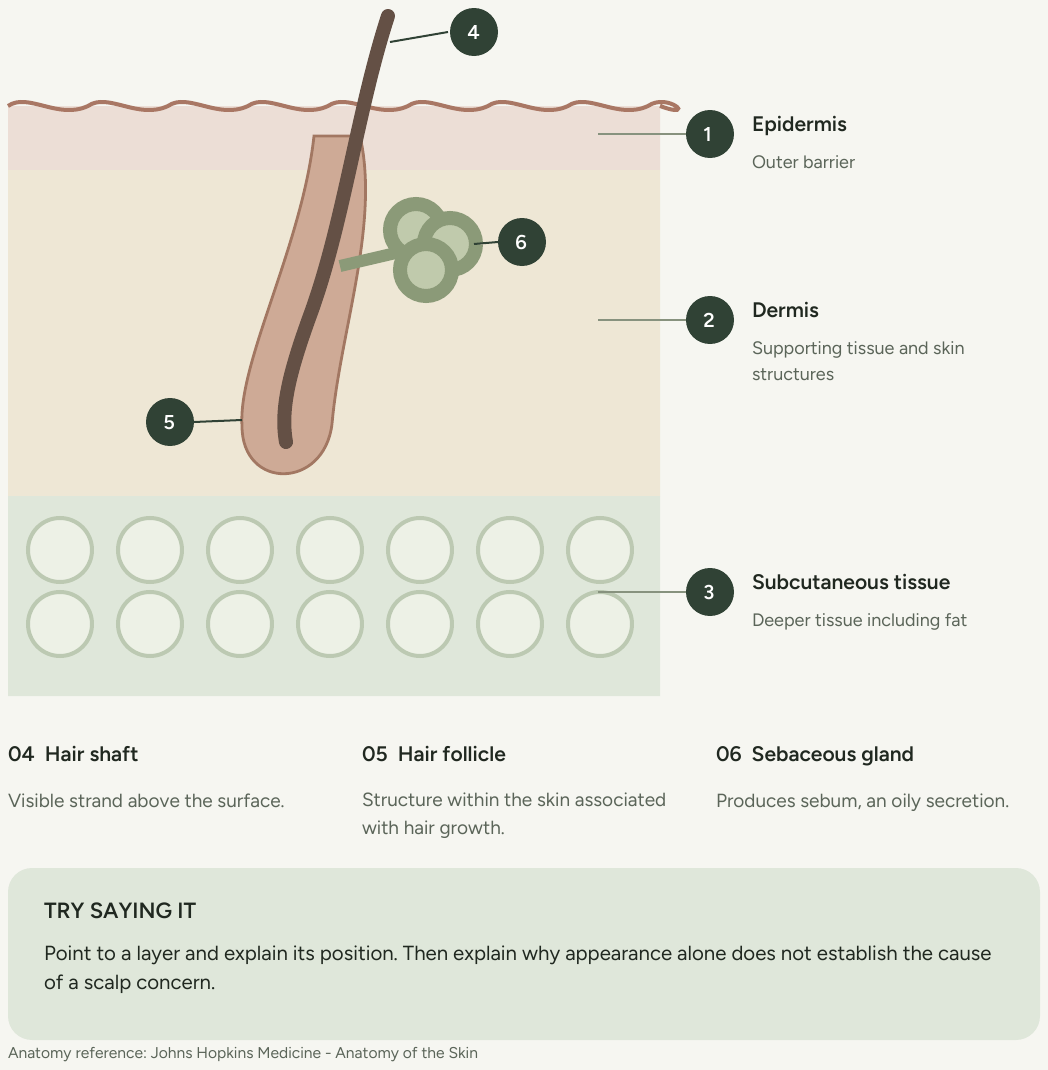
Skin has two main layers. The epidermis is the outer one. It contains no blood vessels and receives its nutrients from the dermis below.
Its outermost layer, the stratum corneum, is made of flattened, dead cells that are shed regularly and replaced roughly every four weeks. Those “dead” cells do important work: they help block microbes, limit dehydration, and protect deeper tissue. Explore the layers of skin with OpenStax.
You may have heard the phrase “skin barrier.” It refers largely to the way the stratum corneum is built: tough, protein-rich cells surrounded by organized layers of lipids, or fats. Read the review of skin barrier function.
Those lipids slow water’s passage out of the skin. The winding route water must take between the cell layers slows it further. Read the review of moisturization and barrier function.
Hydration: water held near the surface
When people talk about skin hydration, they are usually talking about water in the stratum corneum. Two components help hold it there: natural moisturizing factor, a mix of water-attracting compounds inside the cells, and the lipids between them. When this balance is disturbed, the result can be visibly dry, flaky skin. Read the review of skin hydration.
What about drinking more water? A systematic review found the evidence weak in both quantity and quality. It suggested extra water may slightly raise stratum corneum hydration, particularly in people who drink less to begin with, but the mechanism is unknown. Read the systematic review.
The dermis: collagen, elastin, and resilience
Beneath the epidermis, the dermis gives skin much of its strength and spring. Collagen provides strength and structure, and it also binds water. Elastin forms the fibers that let skin stretch and recoil. Hyaluronic acid, a molecule with a strong capacity to retain water, also contributes to skin’s moisture. Read the review of hyaluronic acid in skin.
These materials change over time. Sun exposure is the primary environmental driver of skin aging, and its effects build up alongside the passage of time. Read the review of skin aging. Elastin renews very slowly, its production falls after maturity, and few therapies are capable of repairing elastic fibers. Read the review of elastin in skin.
Hydrated skin is not the same as swelling
This is where Part 4 and Part 5 meet.
Skin hydration is mainly about water held in the outer layers, which affects how the surface looks and feels. Swelling involves excess fluid in the tissues. So skin can feel dry on the surface while a face looks full, and a dewy surface says little about what is happening deeper down.
A plumper or smoother look after a skin-care step is also not evidence of a change in fat, collagen, or lymph. It may simply be a change at the surface, and appearance alone cannot sort out which it is.
What this means for your facial care
The takeaway: facial appearance and comfort involve several interacting tissues, so one session, product, or technique should not be expected to explain or change all of them.
Dry-feeling skin, a tight jaw, and a fuller-looking cheek are different observations that may have different explanations. Telling us about each one, along with your skin-care routine, sensitivities, and recent procedures, leads to clearer choices. Descriptions of skin physiology do not establish that hands-on care rebuilds collagen or elastin, and no facial session replaces medical assessment.
The series in five parts
- Part 1: Your Face Is More Than Skin Deep. Skin, fat, muscle, fascia, ligaments, and bone form one connected system.
- Part 2: What Supports Your Facial Contours? Fascia and retaining ligaments vary by region, and even the definition of the SMAS is debated.
- Part 3: What Moves Your Face and Jaw? Expression and chewing muscles do different jobs, and “tension” describes a feeling rather than a diagnosis.
- Part 4: Facial Fullness: Fat, Fluid, or Something Else? Fat and tissue fluid are different, and a mirror cannot tell them apart.
- Part 5: What Keeps Your Skin Hydrated and Resilient? Barrier, hydration, collagen, and elastin shape the surface, and hydration is not the same as swelling.
Thank you for reading along. If you have questions about your own face, bring them to the studio. We would be glad to talk them through.